

Looking after your scalp while using Optune
Skin irritation is one of the more common challenges people experience when using Optune. The good news is that most skin problems can be managed successfully, particularly when they are spotted and treated early.
Getting into a good scalp care routine can make array changes more comfortable and help prevent small areas of irritation from becoming bigger problems.
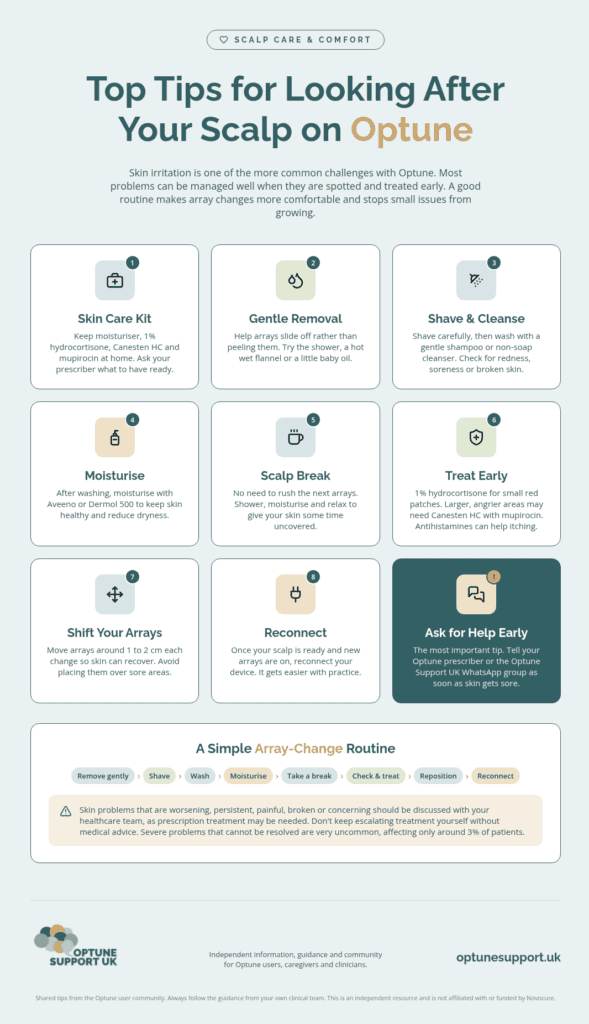
Here are some practical tips for looking after your scalp while using Optune.
1. Have your skin care kit ready
It helps to have everything you might need at home before you develop any irritation.
Useful products to have available include:
- A gentle moisturiser, such as Aveeno or Dermol 500
- 1% hydrocortisone cream
- Canesten HC cream
- Mupirocin cream
Some of these treatments may require advice or a prescription from your healthcare team, so speak to your prescriber about what you should have available and when to use it.
2. Take care when removing the arrays
When it is time for an array change, try to avoid simply peeling the arrays away from your scalp.
Instead, the aim is to help them slide off gently, reducing unnecessary pulling and irritation to the skin.
Some Optune users find it helpful to remove them in the shower or use a hot, wet flannel to loosen the adhesive. Baby oil can also help.
Take your time. Being gentle with the skin during every array change can make a real difference over time.
3. Shave and gently clean your scalp
Once the arrays have been removed, carefully shave your head.
Wash your scalp using a gentle shampoo or a non-soap cleanser, such as Aveeno body wash. Avoid anything particularly harsh that could further irritate sensitive skin.
This is also a good opportunity to have a proper look at your scalp and check for any areas of redness, soreness or broken skin.
4. Moisturise
After washing, moisturise the scalp. Aveeno or Dermol 500 are both options commonly used by members of the Optune community.
Regular moisturising can help keep the skin in good condition and reduce dryness.
5. Give your scalp a break
You don’t have to rush straight into putting the next arrays on.
If you can, use your array change as an opportunity to give your scalp a little time uncovered. Have a shower, moisturise, relax and let your skin have a break before you start again.
6. Treat irritation early
Don’t wait for a small patch of irritation to become a big one.
Small red areas can usually be treated with 1% hydrocortisone cream.
Larger, angrier-looking areas may need treatment with Canesten HC together with mupirocin.
If your scalp is itchy, antihistamines can also be helpful.
Importantly, skin problems that are worsening, persistent, painful, broken or concerning should be discussed with your healthcare team. Don’t keep escalating treatment yourself without medical advice.
7. Move the arrays slightly each time
When you reapply your arrays, reposition them slightly rather than repeatedly placing them over exactly the same areas of skin.
Moving them by around 1–2 cm can give previously covered areas a chance to recover.
You should also try to avoid placing an array directly over an area that is already particularly sore or irritated.
8. Reattach and carry on
Once your scalp is ready and your new arrays are in place, reconnect your Optune device and you’re good to go.
Scalp care can feel like another thing to think about when you first start Optune, but array changes often become much more routine with practice.
The most important tip: ask for help early
If you remember one thing from this guide, make it this: tell someone early if your skin is becoming sore.
Don’t wait until irritation has become difficult to manage.
Contact your Optune prescriber if you’re having problems and, if you’re a member of the Optune Support UK WhatsApp group, ask for advice there too. Other patients and caregivers can often share useful practical experiences, while the clinical team can advise when something needs medical assessment or treatment.
If your skin isn’t improving, further treatment may be needed. This should be reviewed by a healthcare professional as prescription treatment may be required.
Severe skin problems that cannot be resolved are very uncommon, affecting only around 3% of patients. The key is to recognise problems, ask for help and treat them early.
A simple array-change routine to remember
Remove gently → shave → wash → moisturise → take a break → check and treat any irritation → reposition the arrays → reconnect.
And if something doesn’t look right, don’t struggle with it on your own. Ask for help early.
You can also download our Optune scalp care guide as a PDF to save, print or keep handy for your next array change.
